Trace and support Vietnamese goods, easily
Scan to know.Know to choose.
Photograph a label, scan a barcode or type a product name. Mua Việt tells you where it was made, where the brand comes from and who ultimately owns it, with the evidence behind every answer, then surfaces a comparable Vietnamese alternative.
Where Mua Việt came from
We began with the workers who lost their jobs.
On 24 July 2026, exports from Vietnam to the United States took an additional 12.5% reciprocal tariff. For many Vietnamese traders, workshop owners and factory workers, every order that thins out wears away a livelihood.
Mua Việt puts the choice back in the hands of Vietnamese shoppers. Once you know where a product was made, who owns the brand and whose livelihoods that value supports, you can deliberately direct your choice to Vietnamese businesses, workshop owners and workers.
While Vietnamese goods are having a hard time in foreign markets, a small choice at home can become a practical way for Vietnamese people to hold one another up, not only out of pride, but because well-made Vietnamese products deserve the chance to stand firm in their own country.
We are not asking anyone to turn away from imported goods.
A barcode prefix is not a birth certificate
This is the most common misunderstanding about barcodes.
No proprietary QR code. No account.
8934567890128
- Is
- Where the company registered its barcodes
- Is not
- Where the product was manufactured
The prefix 893 tells you a company registered its barcodes with GS1 Vietnam. It does not tell you where the product was made, nor who owns the brand. A Vietnamese company can register an 893 prefix for goods manufactured abroad; a foreign company can perfectly well sell goods made in Vietnam under a different prefix.
That is why barcode registration is its own layer: a signal, not a conclusion.
GS1 on barcode prefixes and country of origin8934563138165
Condiment
Chinsu
Reading the label…
Vietnamese brand · Owned by Masan Group Corporation
A Vietnamese brand whose parent company is Vietnamese too.
8936011601053
Seasoning
Knorr seasoning
Reading the label…
Made in Vietnam · Owned by Unilever PLC
Made in Vietnam, but the parent company sits in the UK and the Netherlands.
Vietnamese goods need to be seen before they can be chosen.
Look it up right at the shelf while you are still deciding, instead of waiting until you get home. And if there is no suitable alternative yet, or not enough solid evidence, we will say so plainly.
- Scan
- Understand
- Compare
- Choose
- Share
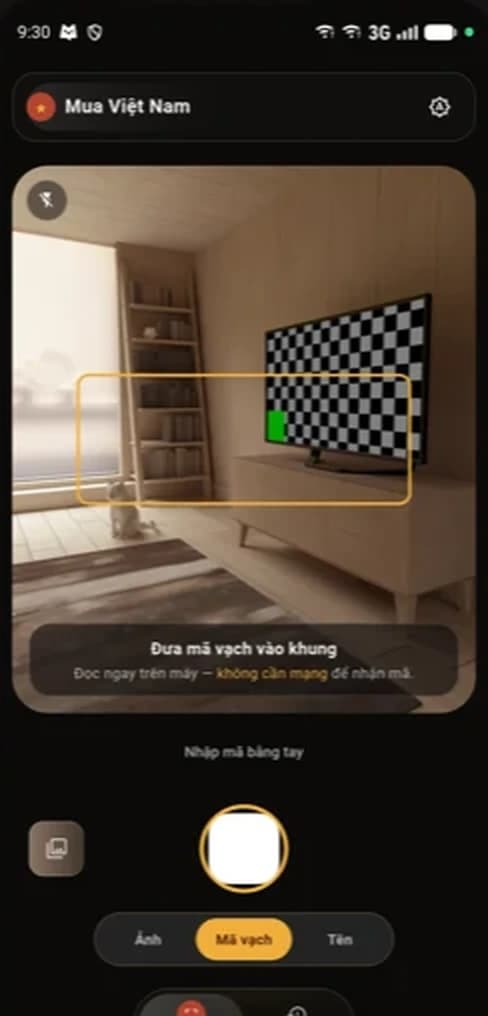
Scan the barcode
Know immediately who makes this.
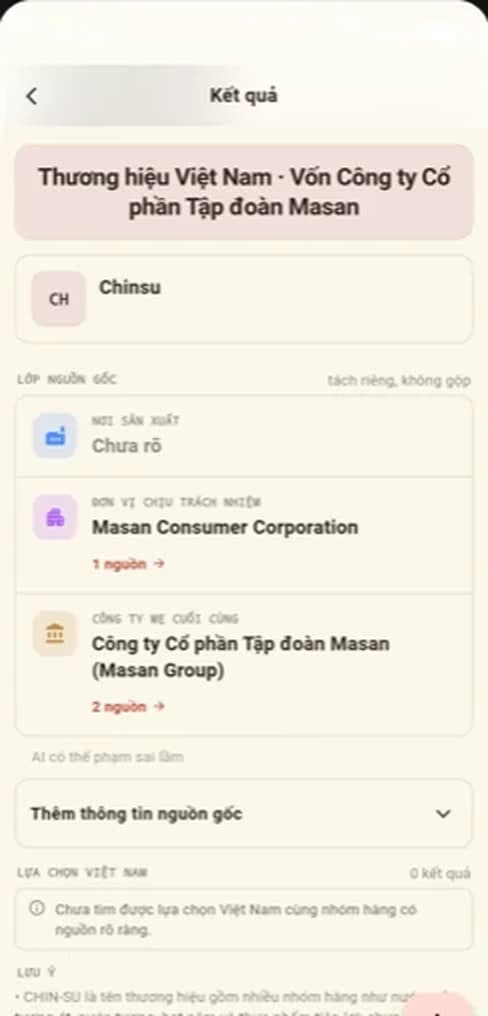
A four-layer report
Manufacturing country, responsible company, parent company.

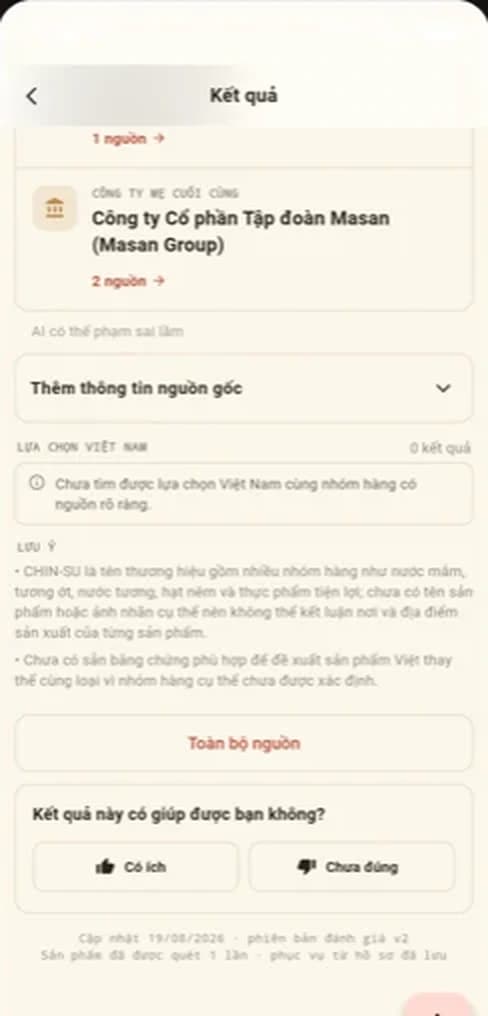
Always with evidence
If we are not sure, we say we are not sure.
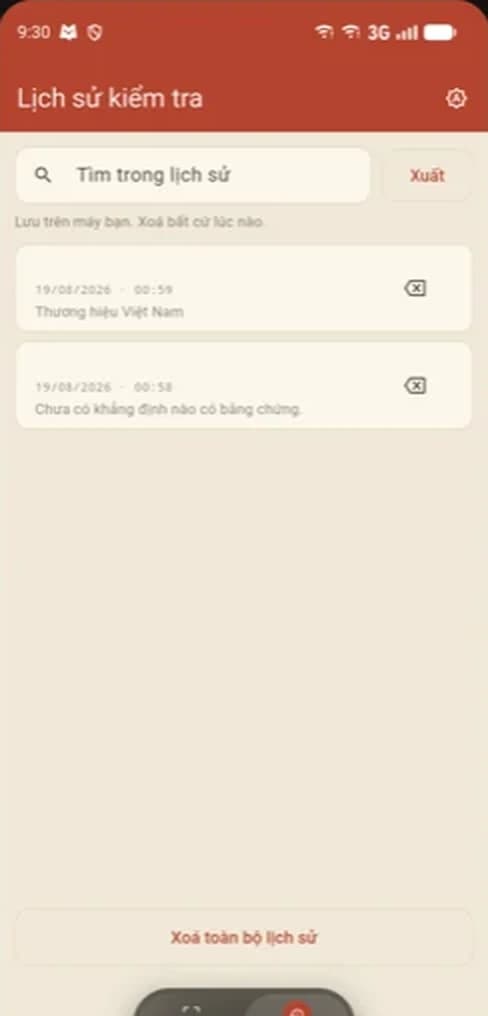
History stays on your phone
Export or erase it whenever you like.
One scan, four separate facts
Four different questions with four different answers. Blurring them together is where every misunderstanding starts.
- Manufacturing country
- Verified
- Where was the product finished or substantially transformed?
- Brand origin
- Declared
- Which country does the brand come from?
- Ultimate parent company
- Verified
- Who ultimately controls it and profits from it?
- Barcode registration
- Inferred
- Which GS1 organisation issued the prefix?
Four layers kept apart, never merged.
Every answer carries its confidence level
Confidence is computed by policy code from the sources actually retrieved, not rated by the model about itself. When two sources disagree we do not average them. That layer stays “Unknown” and waits for human review.
- Verified
A reliable source proves it directly.
- Declared
The company states it; no third party has confirmed it yet.
- Inferred
A reasonable deduction with no confirming source found yet.
- Unknown
Not enough evidence, or the sources contradict each other.
We would rather say we do not know than guess.
Frequently asked questions
The questions people ask most about product origin and how the app works.
Does a barcode starting with 893 mean the product is Vietnamese?
Not necessarily. The 893 prefix only tells you a company registered its barcodes with GS1 Vietnam. It does not prove the product was manufactured in Vietnam, nor does it say who owns the brand. Mua Việt keeps barcode registration as its own layer so you never mistake it for the manufacturing country.
Does Mua Việt need a proprietary QR code from the manufacturer?
No. The app reads the ordinary EAN/GTIN barcode already printed on the packaging, recognises the product from a photo of the label, or looks it up by name. Nothing extra has to be added by the manufacturer.
Is the app free? Do I need an account?
It is free, and there is no account. No email, no phone number, no social login. Your device receives an opaque server-issued token used only to prevent abuse and enforce rate limits.
Are the photos I take stored anywhere?
No. Photos are compressed and stripped of EXIF data on the phone before they are sent, so they never carry GPS coordinates. The server uses the photo to recognise the product and then discards it; the background lookup queue stores only the recognised product name, never the image.
How does the app determine a brand’s ultimate parent company?
By consulting public sources (company registries, official corporate sites, financial disclosures, press coverage) and cross-checking them. Every conclusion carries its sources so you can check for yourself. When they cannot be reconciled, that layer stays “Unknown”.
What is the difference between “Verified” and “Inferred”?
“Verified” means a reliable source proves the claim directly. “Inferred” means the system made a reasonable deduction but has not found a confirming source. The confidence level is computed by policy code from the sources actually retrieved, not claimed by the model itself.
Why does the app sometimes say “Unknown”?
Because there is not enough evidence, or because two sources contradict each other. In a contradiction we do not average them and we do not pick whichever sounds more plausible. The layer stays “Unknown” and goes to human review.
Where do I report incorrect information?
There is a report button on the result screen. You pick the layer that is wrong, enter the correct value and paste a public evidence link. What is displayed does not change until a reviewer approves the correction.
Once you know, the choice is genuinely yours
Mua Việt does not say imported goods are poor, nor that Vietnamese goods are automatically better. It puts the facts on the table and steps back. When a comparable Vietnamese option exists (same category, same use), the app surfaces it for you to weigh. Whether you switch is up to you.
Vietnamese goods, high quality, for Vietnamese people.